If you’re living with HIV or AIDS, you’ve probably faced this question at some point:
“Is there a safer or more manageable way to deal with these symptoms?”
Between medications, side effects, and daily discomfort, managing HIV isn’t just about treatment, it’s about quality of life.
That’s where medical marijuana enters the conversation.
But let’s be clear from the start:
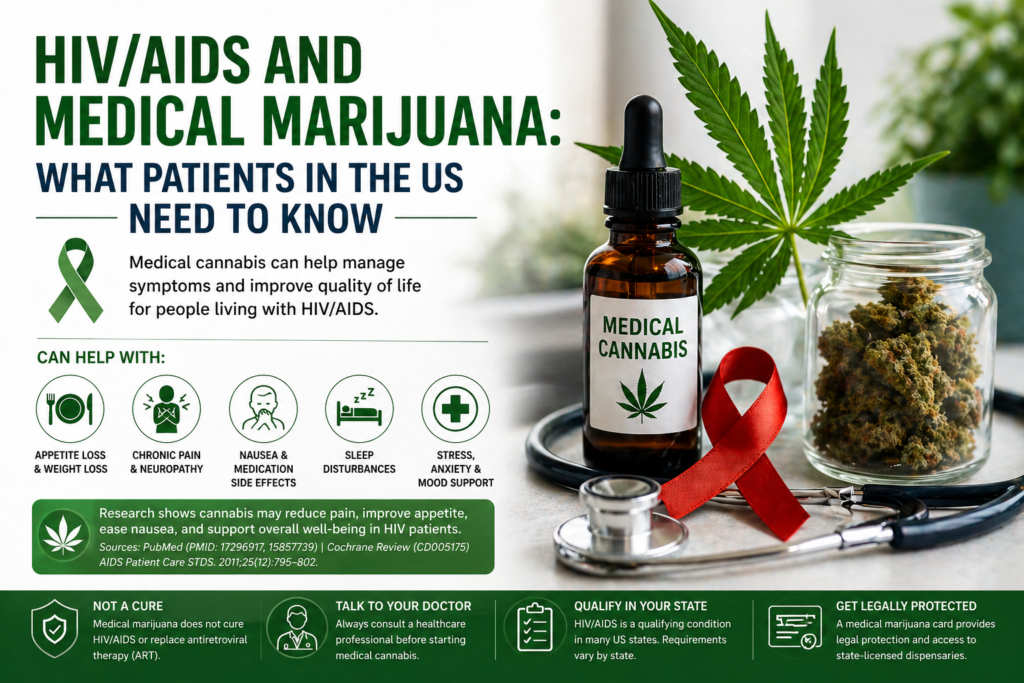
Cannabis is not a cure for HIV/AIDS.
However, it can play a role in helping patients manage symptoms more comfortably.
Let’s break this down in a way that’s medically accurate, simple to understand, and actually useful.
Understanding HIV Symptoms (Why Supportive Care Matters)
With antiretroviral therapy (ART), HIV is now a manageable condition.
But long-term management still comes with challenges:
- Chronic nerve pain (HIV neuropathy)
- Appetite loss and weight loss
- Nausea from medications
- Sleep problems
- Anxiety or mood changes
These are not minor issues. They directly impact quality of life.
That’s why supportive treatments, including medical marijuana, are being studied and used.
Where Medical Marijuana Fits In (What Science Says)
Cannabis works through the body’s endocannabinoid system, which plays a role in:
- Pain signaling
- Appetite regulation
- Mood
- Inflammation
The two main compounds are:
THC – helps with appetite, nausea, and pain
CBD – helps with inflammation, anxiety, and nerve stability
This combination is what makes cannabis relevant in HIV symptom management.
1. Cannabis and HIV Neuropathy (Pain Relief Evidence)
This is one of the strongest areas of research.
HIV-related nerve pain can be difficult to treat. Standard pain medications often don’t fully work.
What Clinical Trials Show
A randomized controlled trial published in Neurology found that:
- Patients using cannabis experienced 34% reduction in daily pain compared to 17% with placebo
- Over 50% of patients achieved significant pain relief
Another controlled clinical trial showed cannabis significantly reduced neuropathic pain in HIV patients who did not respond to traditional treatments
What This Means
From a medical standpoint:
Cannabis is not just anecdotal here, it has measurable analgesic effects for HIV-related nerve pain.
2. Appetite Stimulation and Weight Management
This is one of the oldest and most recognized uses of cannabis in HIV care.
What Research Shows
- Cannabis has been linked to increased appetite and caloric intake in HIV patients (Source)
- A study on appetite hormones showed cannabis increases ghrelin (hunger hormone) and decreases satiety signals (Source)
- 97% of HIV patients using cannabis reported improved appetite (Source)
Why This Matters
Weight loss in HIV can weaken the immune system.
Improving appetite isn’t just about eating more, it supports overall health.
3. Nausea and Medication Side Effects
Antiretroviral therapy is essential, but it can cause nausea.
Cannabis has long been used to reduce nausea, and even pharmaceutical cannabinoids have been approved for similar purposes.
Research reviews confirm cannabis can:
- Reduce nausea
- Improve tolerance to medications
- Support consistent treatment adherence
4. Overall Symptom Relief (What Patients Report)
In observational studies of HIV patients:
- 93% reported reduced nausea
- 90% reported reduced nerve pain
- 93% reported reduced anxiety
- 94% reported improvement in muscle pain (Source)
That’s not small.
It shows cannabis is widely used as a symptom management tool in real clinical settings.
5. What Medical Guidelines Say
Now here’s where we need to stay balanced.
Not all evidence is strong across every symptom.
Clinical reviews show:
- Moderate evidence for pain relief (especially neuropathy)
- Limited evidence for appetite improvement
- Insufficient evidence for long-term disease outcomes (Source)
And a Cochrane review found that while cannabis may improve appetite and mood, studies are often short-term and limited in size
Important Limitations
Medical marijuana:
- Does not treat HIV or slow its progression
- Does not replace antiretroviral therapy (ART)
- Does not work the same for every patient
Side effects can include:
- Drowsiness
- Dizziness
- Cognitive changes
- Potential dependency in some users
There’s also growing research pointing out that benefits are often condition-specific, not universal.
So expectations need to stay grounded.
Is HIV/AIDS a Qualifying Condition?
In most US states, yes.
HIV/AIDS is commonly listed as a qualifying condition for medical marijuana.
But approval still depends on:
- Your symptoms
- Your medical history
- A doctor’s evaluation
How Med Card District Helps You Navigate This
This is where most patients get stuck.
They don’t know:
- If they qualify
- What to say during evaluation
- Whether cannabis is even appropriate for them
That’s where Med Card District comes in.
How the Evaluation Works (From Home)
Med Card District connects you with licensed doctors who understand both HIV care and cannabis medicine.
Here’s how it works:
- You book an online appointment
- A licensed doctor reviews your symptoms and history
- You discuss your condition (pain, appetite loss, nausea, etc.)
- The doctor determines if medical marijuana is appropriate
- If approved, you’re guided through your state’s process
No clinic visits. No confusion.
Just structured medical evaluation.
Why This Matters for HIV Patients
HIV is already complex.
Adding guesswork to treatment decisions makes it worse.
With proper evaluation, you can:
- Understand if cannabis fits your care plan
- Avoid harmful interactions
- Use the right type (THC vs CBD)
- Start safely
A Quick Safety Reminder
If you’re approved:
- Start with low doses
- Do not stop HIV medications
- Avoid mixing substances without guidance
- Monitor how your body responds
- Follow medical advice closely
A Doctor’s Perspective
From a clinical standpoint, medical marijuana has a supportive role in HIV care.
The strongest evidence exists for:
- Neuropathic pain
- Appetite stimulation
- Nausea management
But it is not a primary treatment.
It’s a tool, used carefully, under guidance.
Final Thoughts
Medical marijuana is part of a growing conversation in HIV care.
And for good reason.
There is evidence behind it, but also limitations.
The goal is not to replace treatment.
It’s to improve how you feel while managing the condition.
If you’re considering medical marijuana, Med Card District helps you take that step the right way:
- Evaluated
- Guided
- Supported
No guessing. No confusion. Just clear medical direction.