This is one of the most overlooked questions patients ask.
Everyone talks about pain relief, anxiety, sleep…
But almost no one asks:
“Is this safe for my heart?”
And if you’ve ever had:
- High blood pressure
- Heart disease
- Palpitations
- Or even anxiety-related chest discomfort
This matters more than you think.
The Short Answer
Yes, medical marijuana can affect your heart.
But here’s the key:
For most healthy adults, the effects are mild and temporary.
For patients with existing heart conditions, it requires caution and proper guidance.
What Actually Happens to Your Heart After Using Cannabis?
When you consume cannabis (especially THC), your body responds in a few measurable ways.
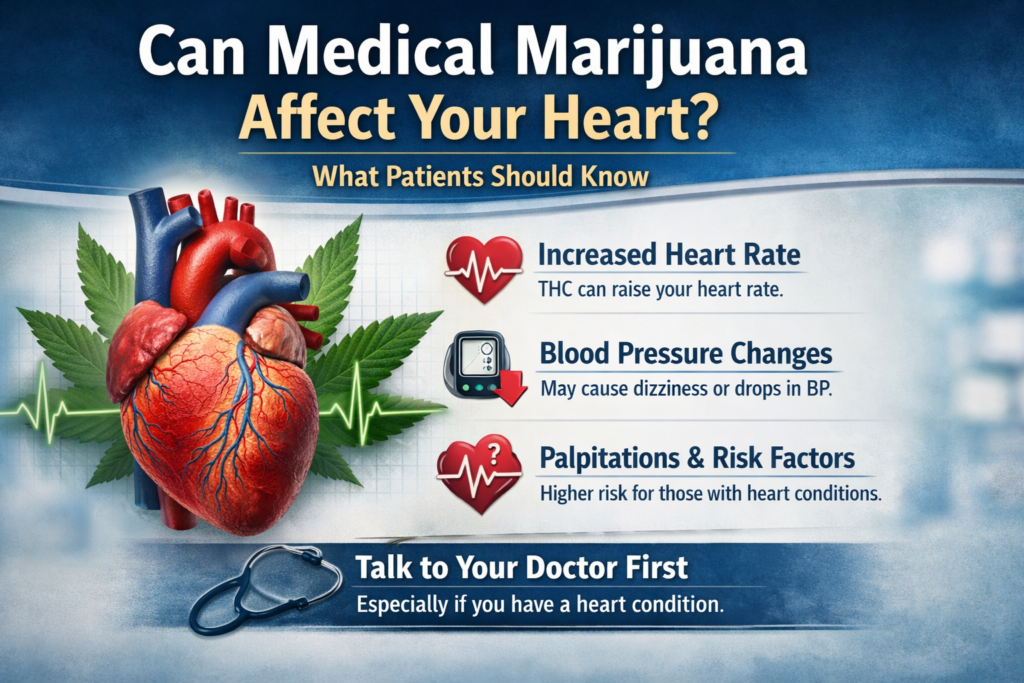
1. Your Heart Rate Can Increase
THC can temporarily increase heart rate — sometimes significantly.
- This is known as tachycardia
- It typically happens shortly after use
- It can last from minutes to a few hours
A clinical review published in the Journal of the American College of Cardiology found that cannabis use is associated with acute increases in heart rate and blood pressure immediately after consumption.
Source:
https://www.jacc.org/doi/10.1016/j.jacc.2020.08.062
For healthy individuals, this is usually not dangerous.
But for patients with cardiovascular disease, this spike can increase strain on the heart.
2. Blood Pressure Can Fluctuate
Cannabis can cause:
- A short-term rise in blood pressure
- Followed by a drop (postural hypotension)
This drop can lead to:
- Dizziness
- Lightheadedness
- Fainting in some cases
A study in Circulation (American Heart Association) notes that cannabis can cause orthostatic hypotension, especially in higher doses.
Source:
https://www.ahajournals.org/doi/10.1161/CIRCULATIONAHA.117.032043
3. It Can Trigger Palpitations
Some patients feel:
- Racing heartbeat
- Irregular beats
- Chest awareness
This is more likely when:
- THC dose is too high
- The patient is anxious
- It’s a first-time experience
A review in European Journal of Preventive Cardiology reported that cannabis may lead to palpitations and transient arrhythmias in susceptible individuals.
Source:
https://academic.oup.com/eurjpc/article/28/1/7/6129974
Is There a Risk of Serious Heart Problems?
Let’s be clear — and balanced.
For most people:
- Risk is low
- Effects are temporary
But research shows potential concerns in high-risk patients.
A large observational study published in JACC found that cannabis use may be linked to an increased risk of heart attack shortly after use, particularly in individuals with existing cardiovascular conditions.
Source:
https://www.jacc.org/doi/10.1016/j.jacc.2020.08.062
Another study in Circulation reported that cannabis use may be associated with increased risk of stroke and cardiovascular events in certain populations.
Source:
https://www.ahajournals.org/doi/10.1161/STROKEAHA.119.027458
Important context:
These risks are rare and mostly affect:
- Older adults
- Patients with pre-existing heart disease
- Heavy or high-dose users
THC vs CBD: Big Difference for Heart Health
Not all cannabis is the same.
THC
- Increases heart rate
- Can raise anxiety
- More likely to trigger palpitations
CBD
- Does not increase heart rate
- May reduce anxiety
- May help lower blood pressure (in some cases)
A study published in JCI Insight found that CBD may reduce resting blood pressure and stress-induced blood pressure responses.
Source:
https://insight.jci.org/articles/view/93760
So if heart health is a concern:
Lower THC + higher CBD is generally the safer starting point.
Smoking vs Other Methods (Important for Heart Health)
How you consume cannabis matters.
Smoking
- Involves combustion
- Can affect lung and cardiovascular health
- May increase overall strain
Edibles / Oils / Tinctures
- No smoke exposure
- More controlled dosing
- Slower onset, longer duration
The American Heart Association recommends caution with smoking cannabis due to potential cardiovascular effects similar to tobacco smoke exposure.
Source:
https://www.heart.org/en/news/2020/08/05/marijuana-may-hurt-heart-more-research-needed
Who Should Be Extra Careful?
You should speak to a doctor before using cannabis if you have:
- Heart disease
- History of heart attack
- Arrhythmias
- High blood pressure
- Stroke history
Also important if you take:
- Blood pressure medications
- Beta blockers
- Blood thinners
Because cannabis can interact with cardiovascular responses.
A Doctor’s Practical Advice
If you’re considering medical marijuana and want to stay safe:
Start with a low dose
Avoid high-THC products initially
Choose non-smoking methods
Monitor how your body responds
Avoid mixing with alcohol
And most importantly:
Don’t self-dose blindly.
What Patients Need to Know
Medical marijuana program exists to reduce risk.
You’re not just buying cannabis, you’re going through a medical evaluation process.
That means:
- Your health history is reviewed
- Risk factors (including heart conditions) are considered
- Your usage is guided medically
This structure helps prevent misuse and improves safety outcomes.
The Bottom Line
So, can medical marijuana affect your heart?
Yes.
But for most people, the effects are mild and temporary.
The real risks come from:
- High doses
- Incorrect product choice
- Existing cardiovascular conditions
- Lack of medical guidance
Used properly, cannabis can be safe.
Used without guidance, it can create avoidable problems.
How Med Card District Helps You Stay Safe
This is where proper evaluation matters.
Med Card District helps patients:
- Get assessed by licensed medical providers
- Identify heart-related and other risk factors
- Choose appropriate cannabis types and dosing
- Avoid common mistakes
- Stay compliant with each State law
You’re not just getting approved.
You’re getting clarity on whether this is actually safe for you.