One of the most common questions I receive from patients beginning medical cannabis therapy is:
“Can I legally and safely drive after using medical marijuana?”
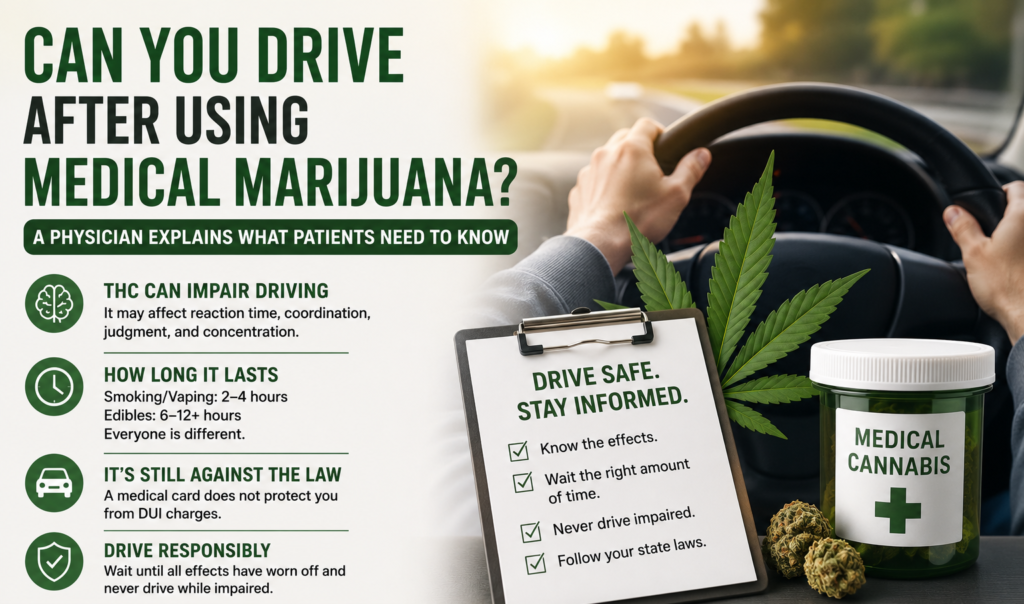
This is an important question because driving requires attention, judgment, coordination, and quick reaction time, all of which can be affected by THC.
From a medical perspective, the answer is straightforward:
You should never drive while impaired by medical marijuana, regardless of whether you are using it legally.
At Med Card District, we educate every patient about responsible cannabis use, including when it is safe to resume daily activities such as driving.
Let’s review what current medical evidence tells us.
How THC Affects Driving Ability
THC (tetrahydrocannabinol) is the primary psychoactive compound found in cannabis.
It interacts with CB1 receptors in the brain, which influence areas responsible for:
- Reaction time
- Hand-eye coordination
- Balance
- Judgment and decision-making
- Attention and concentration
- Short-term memory
- Spatial awareness
Because driving requires all of these functions to work together, even moderate impairment can increase the risk of accidents.
Can Medical Marijuana Make You an Unsafe Driver?
Yes.
Research has shown that THC may temporarily impair driving performance by slowing reaction times and reducing a person’s ability to respond to unexpected situations on the road.
Patients may experience:
Cognitive effects
- Delayed reaction time
- Reduced concentration
- Difficulty multitasking
- Impaired judgment
- Altered perception of distance and speed
Physical effects
- Reduced coordination
- Slower motor responses
- Fatigue or drowsiness
- Blurred focus
The degree of impairment varies from person to person and depends on several important factors.
Factors That Influence Driving Impairment
Not every patient experiences cannabis in the same way.
Several variables determine how long impairment may last.
THC dose
Higher THC concentrations generally produce greater impairment.
Method of consumption
Smoking or vaping:
- Effects begin within minutes
- Peak around 30–60 minutes
- Most impairment lasts approximately 2–4 hours
Edibles:
- Effects begin after 30–120 minutes
- Peak around 2–4 hours
- Impairment may last 6–12 hours or longer
Individual tolerance
Patients who use medical cannabis regularly may feel fewer subjective effects, but this does not necessarily eliminate impairment.
Age and metabolism
Older adults and individuals with slower metabolism may experience prolonged effects.
Other medications
Combining cannabis with alcohol, opioids, sedatives, or sleep medications can significantly increase impairment.
Can You Get a DUI for Driving After Using Medical Marijuana?
Yes.
Having a valid medical marijuana card does not exempt patients from impaired driving laws.
Law enforcement officers evaluate whether a driver appears impaired, regardless of whether cannabis was prescribed for medical purposes.
Depending on your state’s laws, driving while impaired by cannabis may result in:
- DUI or DWI charges
- License suspension
- Fines
- Criminal penalties
- Increased insurance costs
Patients should always familiarize themselves with the driving laws in their state.
How Long Should You Wait Before Driving?
There is no universal waiting period because every patient responds differently.
However, many medical professionals recommend waiting at least:
After smoking or vaping
Approximately 4 to 6 hours, or until all psychoactive effects have completely resolved.
After consuming edibles
At least 8 to 12 hours, and longer if any impairment remains.
Patients should never rely solely on the clock.
If you still feel:
- Drowsy
- Lightheaded
- Relaxed
- Mentally “foggy”
- Less alert than normal
you should not drive.
Can CBD Affect Driving?
CBD (cannabidiol) is not intoxicating like THC.
Most CBD products do not significantly impair driving ability.
However:
- Some CBD products contain small amounts of THC.
- High doses of CBD may cause drowsiness in certain individuals.
Patients should always understand the ingredients in the products they are using.
Warning Signs You Should Not Drive
Do not operate a vehicle if you notice:
- Slower thinking
- Difficulty concentrating
- Trouble focusing on conversations
- Poor coordination
- Blurred vision
- Feeling unusually relaxed or sleepy
- Delayed responses
- Feeling “high”
If any of these symptoms are present, it is safest to arrange alternative transportation.
Clinical Recommendations for Patients
At Med Card District, we encourage patients to follow these evidence-based safety practices:
- Never drive while feeling impaired.
- Start with low THC doses when beginning treatment.
- Avoid combining cannabis with alcohol.
- Allow sufficient time after dosing before driving.
- Consider using cannabis during the evening if it causes drowsiness.
- Discuss dosing schedules with your evaluating physician.
Responsible cannabis use protects both the patient and everyone else on the road.
Frequently Asked Questions
Can I drive if I only use medical marijuana at night?
If all psychoactive effects have completely resolved by morning, many patients are able to drive safely. However, some edible products or high-dose formulations may produce next-day effects.
Does having a medical marijuana card protect me from DUI laws?
No.
Medical marijuana authorization allows qualified patients to legally use cannabis under state law, but it does not permit driving while impaired.
Is it safe to drive if I don’t feel high?
Not always.
Some patients may underestimate their level of impairment. Even if you feel normal, THC can still affect reaction time and decision-making.
Clinical Perspective
Medical marijuana has become an effective treatment option for many qualifying conditions, including:
- Chronic pain
- Muscle spasticity
- Cancer-related nausea
- PTSD
- Sleep disorders
- Certain neurological conditions
Like any medication that affects the central nervous system, cannabis should be used responsibly.
Patients should approach driving with the same level of caution they would use when taking prescription medications that may cause drowsiness or impair judgment.
Conclusion
Medical marijuana can improve quality of life for many patients, but it may temporarily impair the skills required for safe driving.
The safest approach is simple:
Never drive until all effects of THC have completely worn off.
At Med Card District, our physicians help patients understand not only whether they qualify for medical marijuana but also how to use it safely and responsibly. Education is an essential part of effective cannabis therapy, ensuring patients receive the benefits of treatment while minimizing unnecessary risks.