As a physician, one of the most frequent concerns I hear from patients considering medical cannabis is:
“What happens if I take too much THC?”
This is an important and responsible question.
Unlike many conventional medications, cannabis does not have a clearly defined “toxic dose” in healthy adults. However, this does not mean excess THC is without consequences. It simply means the effects are primarily functional and neurological rather than life-threatening in most cases.
At Med Card District, we routinely counsel patients before initiating medical cannabis therapy to ensure they understand both therapeutic effects and potential adverse reactions.
Let’s review this in a clinically accurate and practical way.
Can You Overdose on THC?
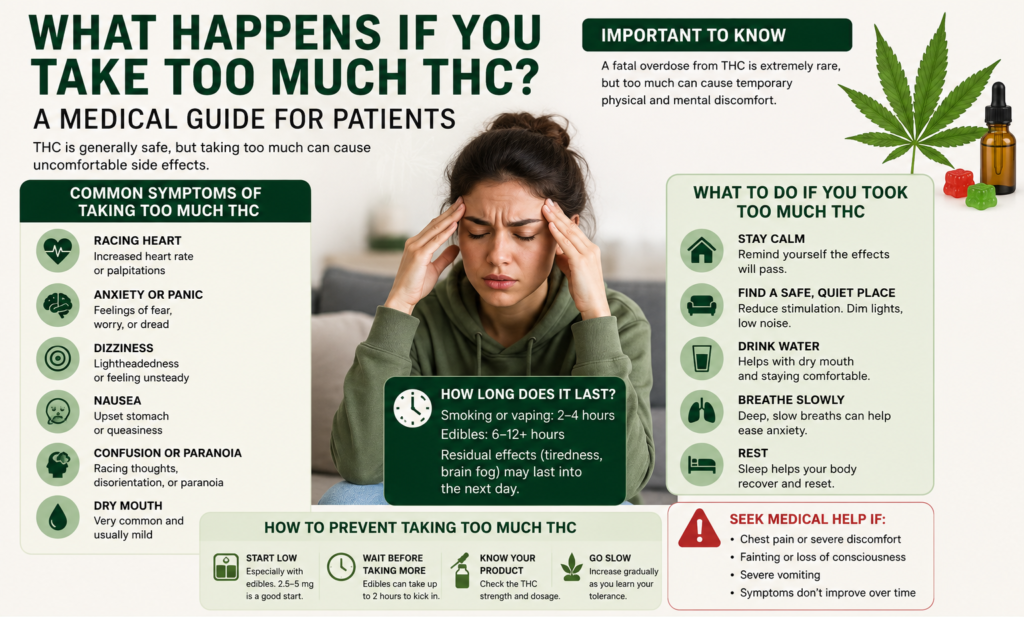
From a medical standpoint, a fatal overdose from THC alone is extremely rare.
However, patients can experience what we call:
Acute cannabis intoxication
This occurs when the dose of THC exceeds an individual’s tolerance and leads to temporary neuropsychiatric and physical symptoms.
While not typically dangerous in healthy individuals, it can be distressing and, in some cases, severe enough to require medical observation.
Clinical Presentation of Excess THC
When a patient consumes more THC than their system can comfortably process, symptoms may include:
Neuropsychiatric symptoms:
- Acute anxiety or panic
- Paranoia
- Confusion
- Impaired short-term memory
- Altered perception of time
- Feeling detached or “unreal” (derealization)
Cardiovascular symptoms:
- Tachycardia (elevated heart rate)
- Palpitations
- Mild blood pressure fluctuations
Gastrointestinal symptoms:
- Nausea
- Vomiting (less common but possible)
- Reduced appetite or dyspepsia
General symptoms:
- Dizziness
- Dry mouth
- Sedation or fatigue
- Impaired coordination
These effects are typically self-limiting and resolve as THC is metabolized.
Why THC Overconsumption Happens Most Often With Edibles
From a pharmacological perspective, the most common cause of excessive THC exposure is oral ingestion (edibles).
This is due to hepatic metabolism.
When THC is ingested orally, it is converted in the liver to 11-hydroxy-THC, a metabolite that:
- Has higher psychoactive potency
- Crosses the blood-brain barrier more efficiently
- Produces delayed but prolonged effects
Key pharmacokinetic profile:
- Onset: 30–120 minutes
- Peak effect: 2–4 hours
- Duration: 6–12+ hours
The primary clinical issue is delayed onset, which often leads patients to unintentionally re-dose before the initial dose has taken effect.
Pathophysiology: Why Symptoms Occur
THC acts primarily on CB1 receptors in the central nervous system, part of the endocannabinoid system responsible for regulating:
- Mood and emotional response
- Stress modulation
- Memory processing
- Autonomic nervous system activity
- Cardiovascular tone
Excess stimulation of CB1 receptors can lead to sympathetic nervous system activation, resulting in:
- Anxiety
- Tachycardia
- Heightened sensory perception
- Cognitive distortion
In susceptible individuals, this may precipitate a panic-like response.
Duration of Symptoms
The duration of adverse THC effects depends on route of administration.
Inhalation (smoking/vaping):
- 2–4 hours typically
- Peak within 30–60 minutes
Oral ingestion (edibles):
- 6–12 hours or longer
- Delayed peak and prolonged recovery phase
High-dose exposure:
- Residual effects (fatigue, cognitive slowing) may persist into the following day
Management of Acute THC Overconsumption
In most cases, treatment is supportive and non-pharmacologic.
Recommended clinical approach:
1. Reassurance
Patients should be informed that symptoms are temporary and self-resolving.
2. Environmental control
Reduce sensory stimulation (quiet, dim environment).
3. Hydration
Oral fluids may assist with comfort and autonomic stabilization.
4. Calming techniques
Controlled breathing may reduce sympathetic activation.
5. Observation
Most patients improve gradually without intervention.
In rare cases of severe anxiety or agitation, clinical supervision may be required.
When Medical Attention May Be Necessary
While complications are uncommon, medical evaluation should be considered if:
- Chest pain is severe or atypical
- Syncope (fainting) occurs
- Severe vomiting persists
- Symptoms do not improve over expected duration
- There is underlying cardiovascular disease
- Severe psychiatric symptoms are present
These presentations warrant exclusion of other medical conditions.
Risk Factors for THC Sensitivity
Certain patients are more susceptible to adverse effects, including:
- First-time cannabis users
- Patients with anxiety or panic disorder
- Individuals with low body mass or low tolerance
- Older adults
- Patients using high-potency products
- Concomitant use of sedatives or psychoactive medications
This variability underscores the importance of individualized dosing in medical cannabis therapy.
Prevention: Clinical Guidance for Safe Use
From a prescribing and counseling perspective, prevention is essential.
Evidence-based recommendations include:
- Initiate with low THC doses (“start low, go slow”)
- Avoid early redosing, particularly with edibles
- Consider CBD-dominant formulations initially
- Educate patients on delayed onset pharmacokinetics
- Encourage documentation of response and tolerance
At Med Card District, physician-led evaluations focus on ensuring patients understand both therapeutic potential and dosing safety before initiating treatment.
Clinical Perspective
It is important to contextualize THC within modern medical practice.
Cannabis may offer therapeutic benefit for conditions such as:
- Chronic pain
- Nausea
- Muscle spasticity
- Anxiety-related disorders (in selected cases)
- Sleep disturbance
However, it remains a dose-sensitive pharmacologic agent with significant inter-individual variability.
Adverse psychological reactions are not uncommon, particularly with high-THC formulations.
Conclusion
Excess THC consumption is rarely medically dangerous, but it can produce significant acute distress.
Symptoms typically include anxiety, tachycardia, perceptual changes, and cognitive impairment. These effects are temporary and resolve as THC is metabolized.
The most important clinical principle remains:
Cannabis response is highly individualized and dose-dependent.
For patients considering medical cannabis, structured medical guidance is essential to reduce adverse effects and improve therapeutic outcomes.
At Med Card District, our approach is to ensure patients receive medically supervised, informed access to cannabis therapy with appropriate education on dosing, safety, and expected effects.