Applying for a medical marijuana card can feel straightforward until your application seems to be taking longer than expected. You may have completed your medical evaluation, submitted your paperwork, and paid the required fee, yet your application may still show as pending.
So, what causes a medical marijuana card application to be delayed?
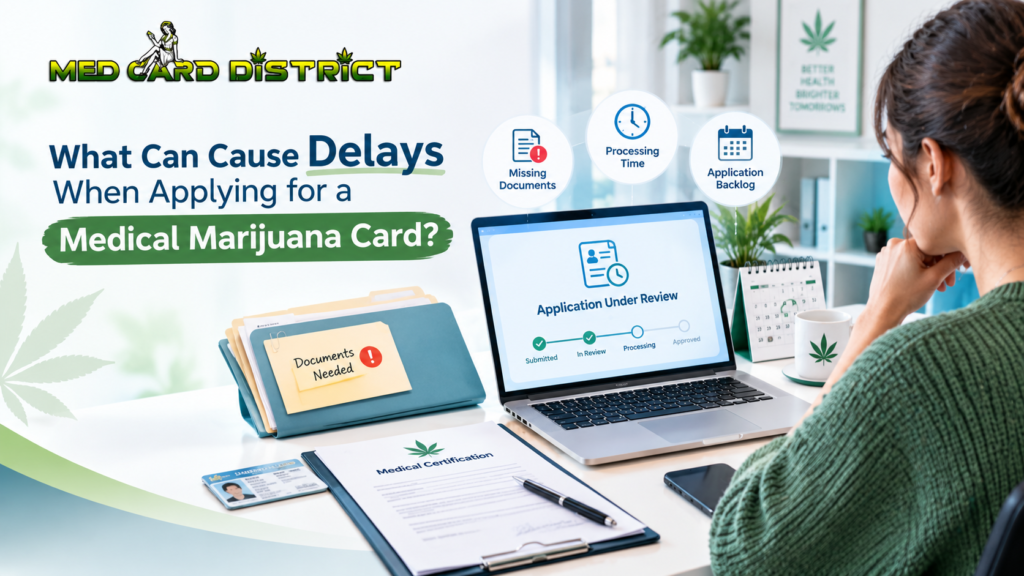
Several things can slow down the process, including missing documents, incorrect information, problems with physician certification, payment issues, residency verification, or simply the state’s normal processing time. The exact requirements and processing times vary by state.
At Med Card District, we help patients understand the medical marijuana card process and prepare for the steps involved. In this guide, we’ll explain the most common reasons applications can be delayed and what you can do if you’re still waiting.
How Long Does It Take to Get a Medical Marijuana Card?
There is no single processing time that applies across the United States.
Each state operates its own medical marijuana program, with different application requirements and processing procedures. Some states process completed applications within a few business days, while others may take longer.
For example, In Kentucky, the Office of Medical Cannabis says it will approve or deny a medical cannabis card application within 30 days after receiving a completed application. If approved, the registry ID card is issued within five days. This means that incomplete or incorrect applications may take longer because the 30-day review period applies to completed applications.
This means you should always check the requirements and published processing time for the state where you’re applying.
A delay does not automatically mean that your application has been denied.
Sometimes, the state is simply reviewing the application. In other situations, the application may need additional information or corrections.
What Can Cause a Medical Marijuana Card Application to Be Delayed?
1. Missing or Incomplete Documents
One of the most common reasons an application may be delayed is missing information or documentation.
Depending on your state, you may need documents such as:
- A government-issued photo ID
- Proof of state residency
- A recent photograph
- Physician certification
- Medical documentation, where required
- Caregiver information, if applicable
- Other state-specific forms
If a required document is missing, expired, unclear, or doesn’t meet the state’s requirements, your application may be returned or placed on hold until the issue is corrected.
What can you do?
Before submitting your application, carefully review the state’s document requirements. Make sure every file is readable and that your identification and other documents are current.
2. Incorrect Information on Your Application
Even a small mistake can create a problem during the review process.
For example, your application could be delayed if information doesn’t match your identification or other records. Common mistakes can include:
- Misspelled legal name
- Incorrect date of birth
- Wrong address
- Incorrect identification number
- Outdated residency information
Before clicking “submit,” take a moment to review every field.
If you’ve already submitted the application and discover an error, don’t submit another application unless your state’s program specifically tells you to do so. Instead, check the program’s instructions for correcting submitted applications.
3. Your Physician Certification Has Not Been Completed
In many medical marijuana programs, a healthcare provider must certify that you have a qualifying medical condition or otherwise meet the state’s requirements. You can check the qualifying conditions recognized by medical marijuana programs before completing your application.
Completing a medical evaluation and completing the state’s application are not always the same step.
Your application may not move forward if your physician has not submitted or completed the required certification.
If you’re waiting: Contact the medical provider who completed your evaluation and confirm that the required certification was submitted successfully.
At Med Card District, we encourage patients to understand each step of the process so they know whether an issue is with their medical evaluation, their state application, or both.
4. Residency Verification Problems
Many state medical marijuana programs require applicants to prove that they live in the state.
Problems can occur when the information on your application does not match your residency documentation.
For example, you may encounter an issue if:
- Your address has recently changed
- Your proof of residency is outdated
- The document doesn’t meet the state’s requirements
- Your application contains a different address
Before applying, check which forms of residency documentation your state accepts.
5. Payment Problems
Some state programs require an application or registration fee.
If payment doesn’t go through correctly, your application may not be considered complete.
Payment problems can happen because of:
- A declined payment
- Incorrect payment information
- An interrupted transaction
- A payment that wasn’t successfully recorded by the state system
If you’ve paid but your application still appears incomplete, check your payment confirmation and the application portal before paying again.
If you’re unsure whether the payment was processed, contact the appropriate state program rather than submitting multiple payments.
6. Your Application Was Returned for Corrections
Sometimes the state reviews an application and determines that something needs to be corrected.
This doesn’t necessarily mean you’ve been denied.
An application may be returned because information is missing, a document isn’t acceptable, or something needs clarification.
If your application has been returned, carefully read the message from the state program. It should indicate what needs to be corrected.
The best approach is to fix the specific issue and resubmit according to the state’s instructions.
7. State Processing Times
Not every delay is caused by an applicant.
Sometimes, your application is complete and simply waiting for the state program to finish its review.
Medical marijuana programs receive applications that must be reviewed according to their individual procedures. Processing times can also vary depending on the state and the type of application.
For this reason, it’s important to compare your waiting time with the official processing timeframe for your state before assuming something is wrong.
8. Technical Problems With the Application Portal
Online medical marijuana applications depend on state websites and registration systems.
Technical issues can sometimes make it difficult to:
- Upload documents
- Complete registration
- Make a payment
- Log into an account
- Submit an application
- Check application status
If you believe a technical problem prevented your application from being submitted correctly, save any confirmation messages or screenshots you have and follow the state’s technical-support instructions.
How Do You Know If Your Application Is Actually Delayed?
The word “pending” can cause unnecessary concern.
A pending application may simply mean that the state has received it and is still reviewing it.
Before assuming that your application has been delayed, check:
- Your application status in the state’s online portal.
- Your email, including your spam or junk folder.
- Messages from your physician or medical provider.
- Your document status to see whether anything needs to be corrected.
- Your payment status if your state requires an application fee.
- The state’s published processing timeframe.
These steps can often tell you whether you need to take action or simply wait for the review to be completed.
Does a Delayed Medical Marijuana Card Mean You Were Denied?
Not necessarily.
A pending or delayed application is different from a denied application.
The exact terminology varies between state programs, but an application may be:
- Pending: The application is still being reviewed.
- Incomplete: Information or documentation is missing.
- Returned: The applicant needs to correct or provide something before the application can continue.
- Approved: The application has met the state’s requirements.
- Denied: The state has determined that the applicant does not meet the applicable requirements.
If your application is pending, don’t assume you’ve been rejected.
Check your state’s application portal and look for any messages explaining whether additional action is required.
How Can You Avoid Delays When Applying for a Medical Marijuana Card?
While you can’t control how quickly a state reviews an application, you can reduce the chances of avoidable problems.
Before submitting your application:
- Double-check your legal name.
- Verify your date of birth.
- Make sure your address is correct.
- Confirm that your identification is valid.
- Gather all required residency documents.
- Make sure your physician certification is completed as required.
- Upload clear and readable documents.
- Review the application before submitting it.
- Confirm that any required payment was successfully processed.
- Save your confirmation information.
- Monitor your email and state application portal after submitting.
Taking a few extra minutes to review your application can help prevent unnecessary corrections later.
What If You Need Help With the Medical Marijuana Card Process?
Medical marijuana application requirements can be confusing, particularly when every state has its own rules.
That’s where understanding the process can make a difference.
Med Card District helps patients navigate the medical marijuana card process by providing information about eligibility, medical evaluations, state requirements, application procedures, and other questions patients commonly have.
If you’re applying for a medical marijuana card, make sure you understand your state’s current requirements before submitting your application. When you have questions about a pending application, always use the official state program as the final source for application status, processing times, and required corrections.
Frequently Asked Questions
Why is my medical marijuana card application taking so long?
A medical marijuana card application may take longer because of missing documents, incorrect information, incomplete physician certification, payment problems, residency verification, technical issues, or normal state processing times. The specific reason depends on your state’s program.
How long should I wait for my medical marijuana card?
There is no nationwide standard waiting period. Each state has its own processing procedures and timelines. Check your state’s official medical marijuana program for the most accurate information.
Can missing documents delay my medical marijuana card?
Yes. If your state requires specific identification, residency documentation, physician certification, or other records, an incomplete application may be returned or delayed until the missing information is provided.
Can an incorrect address delay my application?
It can. If the address on your application does not match your identification or residency documentation, the state may require you to correct the information or provide additional documentation.
Does a pending application mean I was denied?
No. “Pending” generally means the application is still being processed. However, terminology differs between states, so check your state’s application portal for the specific meaning of your status.
What should I do if my application has been pending longer than the stated processing time?
First, check your application status, email, documents, physician certification, and payment. If your application has exceeded the state’s published processing timeframe without an explanation, contact the appropriate state medical marijuana program.
Can Med Card District tell me why my state application is delayed?
Med Card District can help you understand the medical marijuana card process and common application issues. However, the state medical marijuana authority is the appropriate source for the official status of a submitted state application and the reason for a state-level processing delay.
Final Thoughts
Waiting for a medical marijuana card can be frustrating, but a delay doesn’t automatically mean your application has been denied.
Start by checking your application status, email, documents, physician certification, and payment. Then compare your waiting time with the processing timeframe published by your state.
Most importantly, remember that medical marijuana laws and application procedures vary from state to state. Understanding state and federal cannabis laws can help you better understand the rules that apply to you. If your application requires correction or additional information, follow the instructions provided by your state’s medical marijuana program.
At Med Card District, our goal is to make the medical marijuana card process easier to understand so patients can approach each step with greater confidence and fewer surprises.