If you have a medical marijuana card, you may assume that cannabis is simply “legal” for you.
But there is an important legal distinction that every patient should understand:
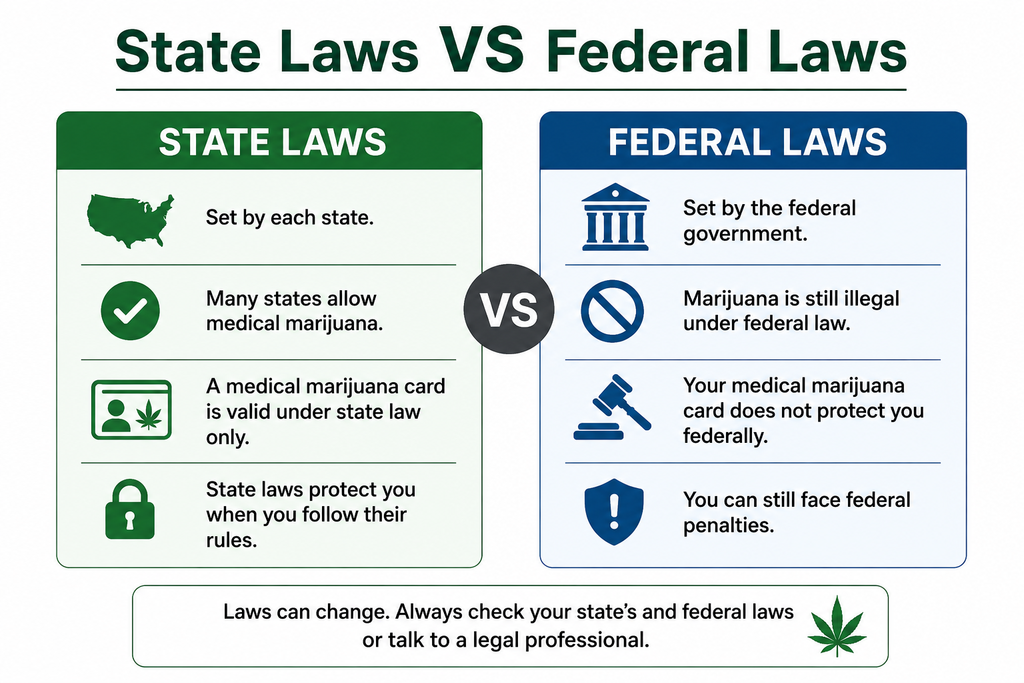
Something can be legal under your state’s cannabis laws while remaining prohibited under federal law.
This difference between state and federal cannabis laws can affect patients, physicians, businesses, travelers, employees, and anyone who uses medical marijuana.
The laws surrounding cannabis are complicated and continue to change. That’s why patients should understand where state protections apply, and where they may not.
Let’s break it down.
State Cannabis Laws vs. Federal Cannabis Laws
The United States has two overlapping legal systems.
State governments can create their own laws governing medical marijuana within their jurisdictions.
The federal government regulates controlled substances under federal law, including through the Controlled Substances Act (CSA).
This has created what is commonly called the federal-state cannabis policy gap.
Congressional Research Service materials explain that many states have adopted laws allowing medical or recreational marijuana even though marijuana remains subject to federal restrictions.
In simple terms:
Your state may allow medical marijuana, but that does not automatically make marijuana legal under federal law.
Is Medical Marijuana Legal Under Federal Law?
This is where things get complicated.
The federal Controlled Substances Act has historically classified marijuana as a Schedule I controlled substance. The DEA’s current drug-scheduling information continues to list marijuana among Schedule I substances.
Under federal law, Schedule I substances are defined as having a high potential for abuse and no currently accepted medical use under the federal scheduling framework.
At the same time, dozens of states have established medical cannabis programs.
That means a patient who legally purchases medical cannabis under state law can still be dealing with a substance that is treated very differently under federal law.
Why Did States Create Medical Marijuana Programs?
State medical cannabis programs developed independently from federal cannabis policy.
California became the first state to establish a medical marijuana law in 1996. Since then, many other states have created their own programs.
Each state can establish its own requirements regarding:
- Qualifying medical conditions
- Patient registration
- Physician certifications
- Possession limits
- Purchase limits
- Caregiver requirements
- Home cultivation
- Dispensary regulations
- Product types
- Renewal requirements
As a result, there is no single set of medical marijuana rules that applies to every patient in the United States.
Having a Medical Marijuana Card Does Not Make Cannabis Federally Legal
This is one of the most important things patients should understand.
A state-issued medical marijuana card generally provides protection under that state’s cannabis laws when the patient follows the program’s requirements.
It does not mean that cannabis has been legalized under federal law.
For example, if a patient is authorized to purchase medical marijuana in their state, they still need to follow that state’s rules regarding where cannabis can be purchased, how much can be possessed, and where it can be used.
The Congressional Research Service has noted that federal law generally prohibits marijuana-related production, distribution, and possession even while states have created legal medical and recreational markets.
Why State Laws Can Be So Different
Medical marijuana programs are not identical from state to state.
One state may list a specific condition as qualifying, while another may use a broader category.
For example, a state may recognize:
- Epilepsy
- PTSD
- Cancer
- Chronic pain
- Multiple sclerosis
- HIV/AIDS
- Certain neurological disorders
Another state may have a completely different list.
Some states also allow physicians greater discretion when determining whether a patient’s condition could benefit from medical cannabis.
This is why patients should never assume that qualifying in one state means automatically qualifying in another.
Can You Take Medical Marijuana Across State Lines?
Patients should be extremely careful here.
A medical marijuana card issued by one state does not automatically give you permission to possess cannabis everywhere in the United States.
Crossing a state line with cannabis can create legal complications because you are moving cannabis from one jurisdiction into another.
Even when both states have medical marijuana programs, their laws may differ.
For that reason, patients should check the laws of both the state they are leaving and the state they are entering before traveling with cannabis.
When traveling, it is generally safer to understand the applicable laws before putting cannabis in your vehicle, luggage, or personal belongings.
What About Federal Property?
State medical marijuana protections generally do not override federal restrictions on federal property.
This can be especially important for places such as:
- National parks
- Federal buildings
- Military installations
- Certain federal facilities
Patients should not assume that because cannabis is permitted in their state, it is automatically permitted on federal property.
The legal authority governing federal property is different from the state law that governs ordinary activities within the state.
What About Airports?
Airports can present another complicated situation because airport property and security operations may involve federal authorities and overlapping state and local rules.
If you are traveling by air, you should check the current rules applicable to your airport, destination, and type of cannabis product before traveling.
A medical marijuana card should not be treated as a universal travel authorization.
Can You Lose Your Job for Using Medical Marijuana?
Possibly.
Medical marijuana laws do not necessarily provide the same employment protections in every state.
Some states have laws that provide certain protections for registered medical cannabis patients, while others provide employers with broader authority regarding workplace drug policies.
There can also be additional complications for:
- Federal employees
- Safety-sensitive positions
- Transportation workers
- Military personnel
- Employees subject to federal regulations
Patients should review their state’s employment protections and their employer’s drug and workplace policies.
Medical Marijuana and Federal Employment
Federal employment can be particularly different from ordinary private employment.
Because marijuana remains federally controlled, federal employees may face restrictions that do not apply to workers employed solely under state law.
A state medical marijuana card does not automatically override federal workplace rules.
If your employment is subject to federal regulations, you should obtain specific guidance before assuming that state authorization protects your cannabis use.
What About Medical Marijuana and Firearms?
This is another area where state and federal law can intersect in complicated ways.
Federal firearms laws and state cannabis laws do not necessarily treat marijuana the same way.
Patients should not assume that holding a medical marijuana card has no effect on their obligations or legal status under federal firearms laws.
Because firearms laws can carry serious consequences, anyone who owns, purchases, or carries firearms should seek qualified legal advice about their particular circumstances rather than relying on general cannabis information.
The FDA and Medical Cannabis
Another important distinction involves FDA approval.
State medical marijuana programs do not mean that the FDA has approved marijuana as a general treatment for medical conditions.
The FDA states that it has not approved a marketing application for cannabis itself to treat any disease or condition. However, it has approved specific cannabis-derived or cannabis-related prescription drugs, including Epidiolex, Marinol, Syndros, and Cesamet for particular medical uses.
This distinction matters.
A state medical marijuana program and FDA drug approval are two different regulatory systems.
A product being available through a state cannabis program does not automatically mean that the FDA has evaluated that specific product as safe and effective for a particular medical condition.
What Is the Difference Between Cannabis and FDA-Approved Cannabinoid Medicines?
Patients sometimes assume that an FDA-approved cannabinoid medicine and medical marijuana purchased from a state dispensary are the same thing.
They are not.
FDA-approved medicines go through a formal drug approval process designed to evaluate safety and effectiveness for specific uses.
For example, the FDA has approved Epidiolex, a purified CBD prescription medicine, for certain seizure disorders. It has also approved medications containing dronabinol and nabilone for specific indications.
Meanwhile, state medical cannabis programs may allow patients to purchase various cannabis products that have not gone through FDA approval as individual prescription drugs.
What Does the 2018 Farm Bill Have to Do With Cannabis?
The 2018 Farm Bill created another important distinction by removing hemp meeting the federal THC threshold from the federal Controlled Substances Act definition of marijuana.
The FDA explains that the 2018 Farm Bill defined hemp as cannabis containing no more than 0.3% delta-9 THC on a dry-weight basis and removed hemp from the CSA, while preserving FDA authority over products containing cannabis-derived compounds.
This is one reason patients may see hemp-derived CBD products widely available even though marijuana remains federally controlled.
However, “hemp-derived” does not automatically mean a product is FDA-approved or appropriate for treating a medical condition.
Does State Legalization Protect Patients From Every Federal Consequence?
No.
State legalization generally establishes a framework under state law.
It does not rewrite federal law.
That distinction is particularly important when patients interact with:
- Federal agencies
- Federal property
- Federal employment
- Interstate transportation
- Certain regulated industries
- Federal firearms laws
- Federal benefit or housing programs
The exact legal consequences depend on the circumstances.
What Should Medical Marijuana Patients Do?
Patients don’t need to become lawyers to use medical cannabis responsibly.
But they should understand the basic boundaries.
1. Know Your State’s Rules
Learn your state’s current requirements for:
- Possession
- Purchasing
- Transportation
- Consumption
- Cultivation
- Patient registration
- Renewal
2. Follow Your Medical Program
Use cannabis according to the rules of your state’s medical cannabis program.
Don’t assume that another state’s rules apply to you.
3. Don’t Assume Your Card Works Everywhere
A medical marijuana card is not necessarily recognized in every state.
Some states have reciprocity programs, while others do not.
4. Be Careful When Traveling
Before traveling, check the current cannabis laws of your destination.
Avoid assuming that cannabis can safely cross state lines simply because it is legal at both ends of your trip.
5. Understand Your Workplace Rules
If your job involves federal regulations, safety-sensitive duties, transportation, or drug testing, investigate the applicable rules before using cannabis.
6. Talk to Your Physician
Your medical marijuana certification is only one part of responsible treatment.
Your physician can also help you understand:
- Appropriate dosing
- THC vs. CBD
- Potential side effects
- Drug interactions
- When not to use cannabis
- When to avoid driving
Why Patients Should Pay Attention to Changing Laws
Cannabis law is not static.
State legislatures continue to modify medical marijuana programs, while federal agencies and lawmakers continue to address federal cannabis policy.
That means an article, social media post, or online forum from several years ago may no longer accurately describe the law today.
For legal questions, patients should rely on current government information or qualified legal professionals.
For medical questions, speak with a licensed healthcare professional.
How Med Card District Helps Patients
Understanding the legal side of medical marijuana can be confusing.
At Med Card District, patients can connect with licensed medical marijuana physicians through telehealth evaluations where permitted by state law.
During an evaluation, a physician can review your medical history, discuss your symptoms, and determine whether you may qualify under your state’s medical cannabis requirements.
If you qualify, Med Card District can help guide you through the state certification process.
The important thing to remember is that a medical marijuana evaluation is not the same thing as a federal authorization to use cannabis.
Your state laws and federal laws can operate differently.
Frequently Asked Questions
Is medical marijuana legal federally?
Generally, no. Marijuana remains controlled under federal law, while many states have established medical cannabis programs.
Why can states allow medical marijuana if federal law restricts it?
States have their own authority to establish and enforce state laws. This has created a legal and policy gap between state cannabis programs and federal prohibition.
Does a medical marijuana card allow me to travel with cannabis?
Not automatically. Patients should check the laws that apply to their specific travel route and destination.
Can I use medical marijuana on federal property?
State authorization does not automatically override federal restrictions. Patients should avoid assuming that state medical cannabis protections apply on federal property.
Is medical marijuana FDA approved?
The FDA has not approved cannabis itself as a treatment for any disease or condition, although it has approved certain specific cannabis-derived and cannabis-related prescription medications.
Can cannabis laws change?
Yes. Cannabis laws and regulations can change at both the state and federal levels. Patients should verify current requirements before making decisions involving cannabis.
Final Thoughts
The biggest misconception about medical marijuana is that legalization means the same thing everywhere.
It doesn’t.
A patient may be legally authorized to use medical cannabis under state law while still facing federal restrictions.
Understanding that difference can help patients make better decisions about traveling, employment, federal property, medication, and responsible cannabis use.
Medical marijuana patients should follow their state’s program carefully, stay informed about changes in the law, and speak with qualified professionals when they have questions.
If you’re considering medical marijuana, Med Card District can connect you with licensed physicians for a professional evaluation and help you understand the medical certification process in your state.
Important Disclaimer
This article is for educational purposes only and is not legal advice. Cannabis laws can change, and federal and state laws may apply differently depending on your circumstances. Patients should consult an attorney for legal advice about their individual situation and check their state’s current medical cannabis regulations before using, purchasing, transporting, or possessing cannabis.
External Sources
- U.S. Drug Enforcement Administration – Drug Scheduling: https://www.dea.gov/drug-information/drug-scheduling
- U.S. Food and Drug Administration – FDA Regulation of Cannabis and Cannabis-Derived Products: https://www.fda.gov/news-events/public-health-focus/fda-regulation-cannabis-and-cannabis-derived-products-including-cannabidiol-cbd
- U.S. Food and Drug Administration – Cannabis Research and Drug Approval: https://www.fda.gov/news-events/public-health-focus/fda-and-cannabis-research-and-drug-approval-process
- Congressional Research Service – The Federal Status of Marijuana and the Policy Gap With States: https://www.congress.gov/crs_external_products/IF/PDF/IF12270/IF12270.7.pdf
- Congressional Research Service – Funding Limits on Federal Prosecutions of State-Legal Medical Marijuana: https://www.congress.gov/crs_external_products/LSB/PDF/LSB10694/LSB10694.3.pdf