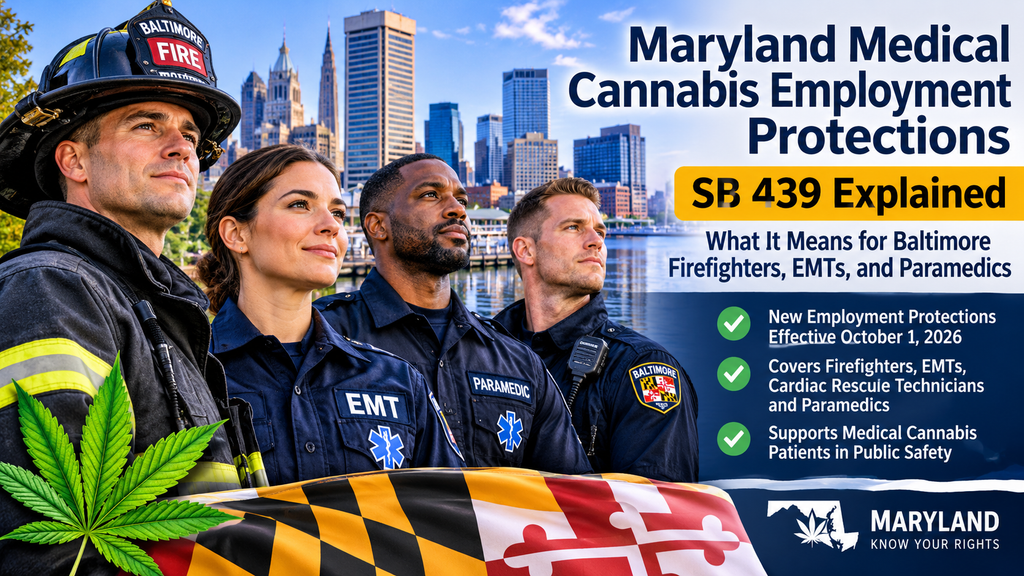
Maryland has introduced an important change for eligible public safety professionals who are also medical cannabis patients. As of October 1, 2026, Senate Bill 439 (Chapter 183) provides specific employment protections for qualifying firefighters, emergency medical technicians (EMTs), cardiac rescue technicians, and paramedics who hold a valid medical cannabis certification.
For public safety professionals in Baltimore and throughout Maryland, this new legislation addresses an important concern: whether having a medical cannabis certification or testing positive for cannabis could automatically put their employment at risk.
Under the new law, certain employers are prohibited from taking specific discriminatory employment actions against eligible public safety employees based on their valid medical cannabis certification or a positive cannabis test while that certification remains valid.
However, the protections come with important conditions, particularly regarding workplace impairment and on-duty cannabis use.
Here is what Maryland Senate Bill 439 means, who qualifies, and what public safety employees should understand about their medical cannabis rights.
What Is Maryland Senate Bill 439?
Maryland Senate Bill 439, officially titled Employment Discrimination – Fire and Rescue Public Safety Employees – Use of Medical Cannabis, was sponsored by Senator Jackson and signed into law by Governor Wes Moore on April 28, 2026.
The legislation became Chapter 183 of the 2026 Laws of Maryland and officially took effect on October 1, 2026.
Its primary purpose is to prevent certain employment discrimination against eligible fire and rescue public safety employees because they possess a valid written medical cannabis certification or test positive for cannabis components or metabolites while holding that certification.
Before this legislation, public safety employees who participated in Maryland’s medical cannabis program could have concerns about how their patient status or a positive drug test might affect their employment.
Senate Bill 439 establishes specific protections under Maryland employment discrimination law for this group of workers.
Importantly, the law does not provide blanket protection to every employee who uses medical cannabis. It specifically identifies eligible fire and rescue public safety employees and establishes conditions that employers must follow.
Who Qualifies for Employment Protection Under Maryland SB 439?
One of the most important parts of Senate Bill 439 is its definition of a fire and rescue public safety employee.
The law identifies four eligible occupational categories:
1. Firefighters
Qualifying firefighters employed by a Maryland municipality, county, the State, the State Airport Authority, or a fire control district are included.
This is particularly relevant for Baltimore-area firefighters and other public employees who may need medical cannabis certification for qualifying medical conditions.
2. Emergency Medical Technicians (EMTs)
Emergency medical technicians employed by the covered public entities are also included.
For EMTs, the law provides protection against certain employment actions based solely on possessing a valid medical cannabis certification or testing positive for cannabis while holding that certification.
3. Cardiac Rescue Technicians
Cardiac rescue technicians are specifically included in the legislation.
This is an important distinction because the law does not limit its coverage to firefighters and EMTs alone.
4. Paramedics
Eligible paramedics employed by the specified government entities also receive these employment protections.
Important eligibility detail: The law defines covered employees based on both their occupation and employer. The employer must be a municipal corporation, county, the State, the State Airport Authority, or a fire control district. Employees of private ambulance companies or other private-sector organizations should not automatically assume they qualify under this particular law.
What Employment Rights Does Maryland Senate Bill 439 Protect?
The central provision of SB 439 is designed to prevent certain discriminatory employment actions against qualifying public safety employees.
Under the new law, an employer may not take the following actions based on an eligible employee’s possession of a valid written medical cannabis certification or a positive cannabis test while the employee holds that certification:
- Discipline the employee.
- Discharge or terminate the employee.
- Discriminate against the employee regarding compensation.
- Discriminate regarding employment terms, conditions, or privileges.
- Limit employment opportunities or otherwise adversely affect the employee’s employment status.
This distinction is important.
The legislation recognizes that a positive cannabis test does not necessarily establish workplace impairment. An employee may have cannabis components or metabolites in their system while maintaining a valid medical cannabis certification.
For eligible employees, SB 439 provides specific protection against employment discrimination based on these circumstances.
It does not mean that employees are exempt from every workplace policy or that employers lose their ability to enforce legitimate safety requirements.
Can Maryland Firefighters and EMTs Use Medical Cannabis While on Duty?
No. Senate Bill 439 does not authorize medical cannabis use while performing public safety duties.
In fact, the legislation specifically preserves an employer’s authority to:
- Establish workplace policies prohibiting employees from performing their duties while impaired by cannabis.
- Prohibit employees from using cannabis while on duty.
The law also establishes an additional reporting requirement.
If a covered fire and rescue public safety employee reports to work while impaired by cannabis, the employer must report the incident to the State Emergency Medical Services Board.
This is an important distinction for employees to understand.
Having a valid medical cannabis certification is different from being impaired at work. Maryland’s new law provides certain employment protections for qualifying patients while maintaining workplace safety standards.
Does a Positive Cannabis Drug Test Mean a Maryland Public Safety Employee Can Be Fired?
Not automatically.
One of the most significant provisions of SB 439 addresses positive cannabis drug tests.
Under the legislation, employers cannot discipline, discharge, or otherwise discriminate against an eligible fire and rescue public safety employee because the employee tests positive for cannabis components or metabolites while holding a valid written medical cannabis certification.
However, this protection is subject to the law’s conditions and exceptions.
For example, employers retain the ability to enforce policies prohibiting workplace impairment and on-duty cannabis use.
The legislation also does not require employers to take actions that would violate federal law or regulations or cause them to lose a monetary or licensing-related benefit under federal law or regulations.
Therefore, public safety employees should understand their individual employment policies and the specific circumstances that may affect their eligibility for protection.
Why Is This New Law Important for Baltimore Medical Cannabis Patients?
Baltimore and the surrounding Maryland communities have thousands of professionals working in emergency response and public safety.
Firefighters, EMTs, cardiac rescue technicians, and paramedics perform demanding jobs that require physical readiness, sound judgment, and the ability to respond to emergencies.
Some individuals in these professions may also have qualifying medical conditions for which a healthcare provider determines that medical cannabis may be appropriate.
However, employment concerns can make people hesitant to explore medical cannabis certification.
Maryland Senate Bill 439 addresses part of that concern by establishing employment protections for a specifically defined group of public safety employees.
For eligible patients, the legislation provides greater clarity about how their valid medical cannabis certification and certain positive drug tests must be treated under Maryland employment discrimination law.
This is particularly important for Baltimore residents who work in qualifying public safety positions and want to understand their rights before pursuing medical cannabis certification.
How Can Public Safety Employees Get a Maryland Medical Cannabis Card?
Public safety professionals who are interested in medical cannabis should first understand Maryland’s certification requirements.
The Maryland medical cannabis program requires patients to obtain a written certification from a qualified certifying provider who has established a bona fide provider-patient relationship.
The general process involves:
Step 1: Understand the eligibility requirements
Review Maryland’s medical cannabis program requirements and determine whether you may qualify for certification.
Step 2: Consult a qualified medical provider
Schedule an assessment with a Maryland-authorized certifying provider. The provider reviews your medical history and current medical condition.
Step 3: Obtain a written certification if approved
If the provider determines that you meet the program’s requirements and that the potential benefits outweigh the health risks, they may issue a written medical cannabis certification.
Step 4: Complete the applicable registration requirements
Follow the Maryland Cannabis Administration’s applicable registration and identification procedures.
Step 5: Maintain valid certification
If you are relying on the employment protections under SB 439, maintaining a valid written certification is particularly important.
Remember that receiving a medical cannabis certification does not automatically establish eligibility for employment protection. Your occupation, employer, certification status, and applicable workplace requirements all matter.
Frequently Asked Questions About Maryland Medical Cannabis Employment Protections
When did Maryland Senate Bill 439 take effect?
Maryland Senate Bill 439 (Chapter 183) took effect on October 1, 2026. Governor Wes Moore approved the legislation on April 28, 2026.
Does Maryland SB 439 protect firefighters with medical marijuana cards?
Yes. Eligible firefighters employed by a municipality, county, the State, the State Airport Authority, or a fire control district are included in the legislation’s employment protections.
Are EMTs and paramedics covered under the new Maryland law?
Yes. Eligible emergency medical technicians, paramedics, and cardiac rescue technicians are specifically included, provided they meet the law’s employment requirements.
Can an employer fire an eligible employee for testing positive for cannabis?
Under SB 439, an employer generally cannot discipline or discharge an eligible fire and rescue public safety employee based on a positive cannabis test while the employee holds a valid written medical cannabis certification. However, statutory exceptions and workplace safety requirements still apply.
Does the law cover private ambulance company employees?
Not automatically. The law defines covered public safety employees by their occupation and the specified types of employers. Employees of private ambulance companies should seek clarification about their particular employment circumstances.
Can public safety employees use cannabis before or during their shifts?
SB 439 does not authorize on-duty cannabis use or working while impaired. Employers may prohibit both on-duty use and performing duties while impaired.
Does having a Maryland medical cannabis card guarantee job protection?
No. The law provides specific protections for qualifying public safety employees, not every Maryland medical cannabis patient. Employees should review their eligibility and consult an employment attorney when necessary.
Understanding Your Medical Cannabis Options in Maryland
Maryland’s Senate Bill 439 represents an important development in the relationship between medical cannabis access and employment rights for eligible public safety professionals.
For Baltimore firefighters, EMTs, paramedics, and cardiac rescue technicians, understanding the new legislation is an important first step toward making informed decisions about medical cannabis certification.
While the law does not eliminate workplace safety requirements or provide universal employment protection, it establishes specific safeguards for qualifying employees who hold valid medical cannabis certifications.
If you are considering medical cannabis in Maryland, understanding the certification process and the state’s current requirements can help you take the next step with greater confidence.
Med Card District helps Maryland residents understand the medical cannabis certification process and access the resources they need to get started.
Visit Med Card District to learn more about obtaining a Maryland medical cannabis card.
Legal Disclaimer: This article is intended for educational and informational purposes only and does not constitute legal or medical advice. Employment protections under Maryland Senate Bill 439 are subject to statutory eligibility requirements, conditions, and exceptions. A medical cannabis certification does not authorize on-duty use or working while impaired. Consult a qualified employment attorney for advice about your individual employment circumstances.
Official Legislative Source: Maryland General Assembly, Senate Bill 439 (Chapter 183), 2026 Laws of Maryland.