
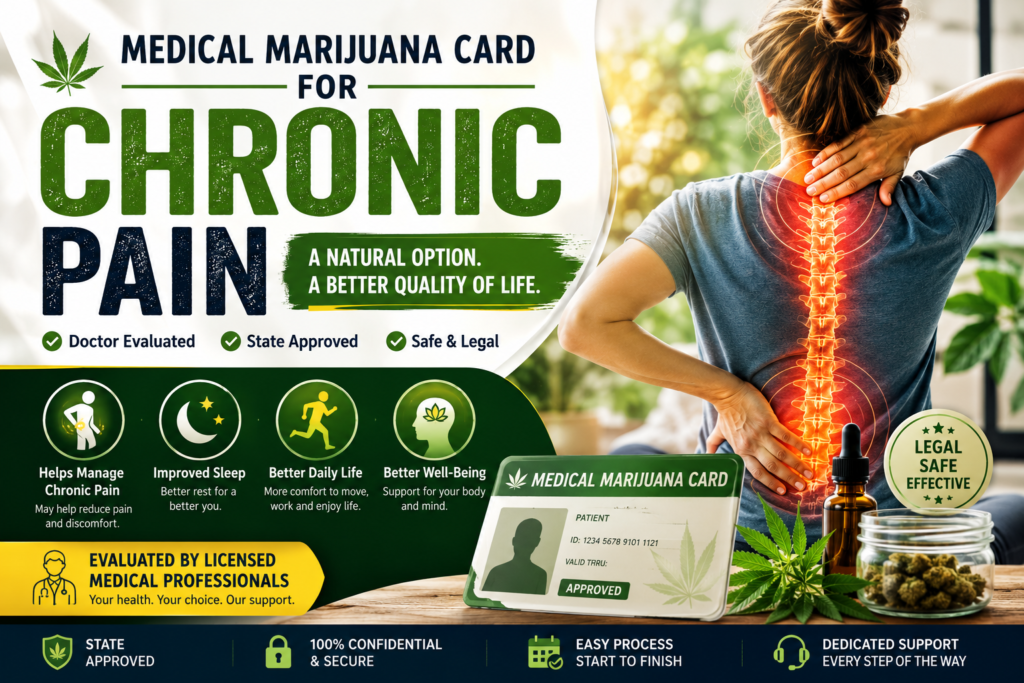
Chronic pain is more than an occasional ache. When pain stays for months or keeps coming back, it can affect your sleep, work, movement, and everyday life. Many people try medications, physical therapy, lifestyle changes, or other treatments before looking into medical cannabis.
If you are in this situation, you may have one simple question:
Can I get a medical marijuana card for chronic pain?
The answer depends on where you live and your individual medical situation. Some state medical cannabis programs recognize chronic pain as a qualifying condition, but patients still need to meet their state’s requirements and receive an evaluation from an authorized medical professional.
If you are considering medical cannabis for ongoing pain, understanding the qualification process can help you decide what to do next.
What Is Chronic Pain?
Chronic pain is pain that continues for a long period or keeps returning over time. It can develop from an injury, nerve problems, arthritis, a medical condition, surgery, or another underlying cause.
Unlike short-term pain, chronic pain can become part of a person’s daily routine.
It may affect:
- Sleep
- Walking and movement
- Work
- Exercise
- Concentration
- Household activities
- General quality of life
Chronic pain can also look different from one person to another. One person may experience a constant dull ache, while another may have burning, shooting, or sharp pain.
That is why a medical evaluation should look at the cause, severity, duration, and impact of your pain, rather than simply asking whether you have pain.
Can Chronic Pain Qualify You for a Medical Marijuana Card?
In many medical cannabis programs, chronic pain can be a qualifying condition. However, qualification is not automatic.
Each state has its own rules about who can receive medical cannabis certification.
For example, Med Card District currently serves patients in Kentucky, Maryland, and Pennsylvania. Its state pages list chronic pain among the conditions considered for medical marijuana certification.
The important point is that having chronic pain does not mean you should assume you will automatically receive a card. A qualified medical professional needs to review your situation according to the rules in your state.
How Can Medical Marijuana Help With Chronic Pain?
People with chronic pain often look for another treatment option when their current approach is not providing enough relief.
Medical cannabis may help some patients manage pain symptoms. Research has found that certain cannabis-based treatments can provide small short-term improvements in chronic pain, particularly in some patients with neuropathic pain.
However, the response is not the same for everyone.
Medical cannabis should therefore be viewed as a potential treatment option rather than a guaranteed solution.
A medical marijuana evaluation gives you an opportunity to discuss your pain with a qualified professional and determine whether cannabis may be appropriate for your individual situation.
What Types of Chronic Pain May Be Relevant?
Chronic pain can have many causes, and not every type of pain has the same medical background.
Some patients experience pain related to:
- Nerve damage
- Arthritis
- Long-term injuries
- Musculoskeletal conditions
- Fibromyalgia
- Persistent back or neck problems
- Other chronic medical conditions
Neuropathic pain is one area that has received particular attention in cannabis research.
This type of pain is related to nerve damage or abnormal nerve signaling. Patients may describe it as burning, tingling, shooting, electric, or unusually sensitive to touch.
The type of pain you experience is important during an evaluation because your doctor needs to understand what is causing your symptoms and how they affect you.
When Should You Consider a Medical Marijuana Evaluation?
You may want to discuss medical cannabis with a qualified doctor if your pain has become an ongoing problem and you are looking for additional treatment options.
A medical evaluation may be worth considering if:
- Your pain has continued for months.
- Your pain interferes with normal activities.
- Your pain affects your sleep.
- Previous treatments have not provided enough relief.
- You have a diagnosed condition associated with chronic pain.
- You want to understand whether medical cannabis is an appropriate option for you.
You do not need to decide on your own that medical marijuana is the right treatment.
That is what the evaluation is for.
What Does a Medical Marijuana Evaluation for Chronic Pain Involve?
The evaluation is mainly about understanding your medical situation.
Your medical marijuana doctor may ask about:
How Long You Have Had Pain
Be prepared to explain when your pain started.
If it began after an accident, surgery, illness, or another event, mention that.
Where You Feel Pain
Tell the doctor exactly where your pain occurs.
For example, you may have pain in your lower back, joints, legs, shoulders, or several areas.
What Your Pain Feels Like
Try to describe the sensation clearly.
You might experience:
- Aching
- Burning
- Sharp pain
- Throbbing
- Tingling
- Shooting pain
- Numbness
- Pressure
These details can help your doctor understand your condition.
How Often the Pain Occurs
Some people experience pain every day. Others have periods when their symptoms become much worse.
Explain your normal pattern and how often you experience flare-ups.
How Pain Affects Your Daily Life
This is an important part of your evaluation.
Tell the doctor if your pain makes it difficult to:
- Sleep
- Work
- Walk
- Exercise
- Drive
- Complete household tasks
- Spend time with family
- Concentrate
The goal is to give the doctor an accurate picture of your condition.
What If Other Treatments Have Not Worked?
This is a common concern among people with chronic pain.
You may have already tried prescription medication, over-the-counter pain relievers, physical therapy, injections, exercise, or other treatments.
If those treatments did not provide enough relief, tell your medical marijuana doctor.
You should also explain whether a treatment helped temporarily, caused unwanted effects, or did not help at all.
This information can help the doctor understand your treatment history.
However, do not stop a prescribed medication simply because you are considering medical cannabis. Discuss changes to your treatment plan with your healthcare professional.
Do You Need Medical Records to Get a Medical Marijuana Card?
The documentation requirements depend on the state and the circumstances of your evaluation.
If you have medical records related to your chronic pain, it can be useful to have them available.
Relevant information may include:
- Your diagnosis
- Previous treatment records
- Medication history
- Imaging results
- Specialist reports
- Information about previous procedures
You should not worry if you do not have a large collection of medical documents.
Instead, ask the clinic what information is required before your appointment.
Does the Severity of Chronic Pain Matter?
Yes, the details of your pain matter.
A patient who has occasional mild discomfort may have a very different medical situation from someone whose chronic pain prevents them from sleeping or working normally.
During your evaluation, be honest about the level of pain you experience.
Explain:
- How often it happens
- How severe it becomes
- How long flare-ups last
- What activities make it worse
- What treatments you have already tried
- How it affects your normal routine
Do not exaggerate your symptoms.
Accurate information helps the medical professional make a proper assessment.
What Happens If You Qualify?
If the medical professional determines that you meet the requirements for medical cannabis certification, the next steps depend on your state.
The certification process is not identical everywhere.
For example, Med Card District currently offers in-person evaluations for Kentucky patients at its Lexington clinic, while Maryland and Pennsylvania patients can access online telehealth evaluations.
After receiving the required medical certification, you may need to complete additional registration with your state’s medical cannabis program before you can legally purchase medical cannabis.
Your doctor or clinic should explain the next steps applicable to your state.
How to Get a Medical Marijuana Card for Chronic Pain
The process can be easier when you break it into a few simple steps.
Step 1: Confirm Your State’s Requirements
Start by checking whether chronic pain or your underlying condition can qualify under your state’s medical cannabis program.
Do not rely only on information from another state because the rules can be different.
Step 2: Schedule a Medical Evaluation
Choose a licensed medical marijuana doctor who can evaluate your condition.
The doctor will review your symptoms, medical history, and treatment experience.
Step 3: Explain Your Chronic Pain Clearly
Give the doctor an honest description of your condition.
Explain when the pain started, what it feels like, what treatments you have tried, and how it affects your daily life.
Step 4: Receive Your Certification If Approved
If you meet the applicable requirements and the doctor determines that medical cannabis is appropriate, you can receive the required certification.
Step 5: Complete Your State Registration
Depending on where you live, you may need to register with the state’s medical cannabis program and complete any required application steps.
Once the process is complete, you can use your certification or card according to your state’s medical cannabis laws.
Medical Marijuana Card for Chronic Pain in Kentucky
Kentucky patients with chronic pain can explore their eligibility through Med Card District’s Kentucky Medical Marijuana Card program. The clinic’s Kentucky page lists chronic pain among the conditions considered for medical cannabis certification and provides in-person evaluations at its Lexington location.
If you are a Kentucky resident dealing with ongoing pain and want to know whether you may qualify, a medical evaluation is the right place to discuss your condition, medical history, and eligibility.
Medical Marijuana Card for Chronic Pain in Maryland
Maryland patients can complete their medical marijuana evaluation through telehealth with Med Card District.
The clinic’s Maryland program lists chronic pain as a qualifying condition and allows eligible patients to complete their evaluation online.
This can be especially helpful for patients who have difficulty traveling to a clinic because of pain or mobility problems. If you are dealing with ongoing pain and want to explore your eligibility, the Maryland Medical Marijuana Card online process allows you to discuss your condition with a qualified medical professional from home.
Medical Marijuana Card for Chronic Pain in Pennsylvania
Pennsylvania patients experiencing chronic pain can explore their eligibility for a medical marijuana card through Med Card District’s Pennsylvania program.
Chronic pain may qualify under Pennsylvania’s medical marijuana program when it meets the state’s eligibility requirements. Patients can discuss their symptoms, medical history, and treatment options during a medical evaluation to determine whether they may qualify.
If you are a Pennsylvania resident dealing with ongoing or severe pain, a medical marijuana evaluation can help you understand your eligibility and the steps involved in obtaining a Pennsylvania medical marijuana card.
What Should You Expect From the Process?
Getting a medical marijuana card should not feel like a guessing game.
You should know:
- Whether your condition may qualify
- What information you need for your evaluation
- What happens during the appointment
- What your state requires after certification
- When you need to renew your certification
A patient-focused evaluation should give you clear answers instead of simply telling you to apply and figure everything out yourself.
Is Medical Marijuana a Cure for Chronic Pain?
No treatment should be presented as a guaranteed cure for chronic pain.
Medical cannabis may help some patients manage their symptoms, but results vary. Research suggests that benefits can be modest, and medical cannabis may also cause unwanted effects.
The goal of an evaluation is therefore not to promise that cannabis will eliminate your pain.
The goal is to determine whether medical cannabis may be a reasonable option for your particular condition.
That distinction is important.
Why a Professional Evaluation Matters
Chronic pain can have many different causes.
If you only focus on the pain itself, you may miss information that could be important to your overall treatment.
A medical marijuana evaluation gives you the opportunity to explain your symptoms and treatment history to a licensed professional.
The doctor can then determine whether you may qualify under the applicable state program and whether medical cannabis is an appropriate option to discuss.
For patients who have been dealing with chronic pain for a long time, having that conversation can be a useful next step.
Frequently Asked Questions
Can I get a medical marijuana card for chronic pain?
You may qualify, depending on your state and your medical situation. Chronic pain is listed among the conditions considered by Med Card District in Kentucky, Maryland, and Pennsylvania.
Do I need a diagnosis to apply for a medical marijuana card?
Requirements vary by state. A medical marijuana doctor will review your medical history and symptoms and determine whether you meet the applicable requirements.
What should I tell the doctor about my chronic pain?
Explain when your pain started, where you experience it, what it feels like, how often it occurs, what treatments you have tried, and how it affects your daily life.
Can I qualify if traditional pain treatments have not helped?
Previous treatment history can be relevant during an evaluation. Tell your doctor which treatments you have tried and whether they helped.
Can I get a medical marijuana evaluation online?
It depends on your state. Med Card District currently provides online telehealth evaluations for Maryland and Pennsylvania, while its Kentucky evaluations are conducted in person at its Lexington clinic.
How long does a medical marijuana certification last?
The duration depends on state requirements. Med Card District states that most certifications are valid for up to one year, although some states may have different rules.
What if I am not sure whether my chronic pain qualifies?
You do not have to determine your eligibility by yourself. Schedule an evaluation with a licensed medical marijuana practitioner and explain your condition honestly. The doctor can review your situation and determine whether you may qualify.
Take the Next Step for Chronic Pain
Living with chronic pain can make everyday life difficult. If your current treatment approach is not providing enough relief, it may be worth discussing medical cannabis with a qualified professional.
The first step is not guessing whether you qualify.
The first step is getting your condition evaluated.
Med Card District provides medical marijuana evaluations for qualifying patients in Kentucky, Maryland, and Pennsylvania, with services designed around each state’s requirements.
If you are dealing with chronic pain and want to understand whether you may qualify for a medical marijuana card, schedule an evaluation and discuss your condition with a licensed medical professional.