Cannabis laws in the United States can be confusing, especially when some states allow medical marijuana, others permit recreational use, and some have both programs. If you’re considering cannabis for a health-related reason, you may wonder whether you need a medical marijuana card or whether recreational marijuana is enough.
Although both options involve cannabis, medical marijuana and recreational marijuana are not the same thing from a legal or practical standpoint. They can differ in eligibility requirements, purchasing rules, possession limits, taxes, patient protections, and access to certain products.
Understanding these differences can help you make a more informed decision about the options available in your state.
In this guide, we’ll explain how medical marijuana cards compare with recreational cannabis, what benefits a medical card may offer, and when speaking with a qualified medical professional may be worthwhile.
What Is a Medical Marijuana Card?
A medical marijuana card is an identification document or registration credential issued through a state’s medical cannabis program. It allows an eligible patient to purchase and possess medical cannabis according to that state’s laws.
The process generally involves an evaluation by a qualified healthcare professional. The provider reviews the patient’s medical history, symptoms, and health concerns to determine whether the patient may qualify under the state’s medical cannabis requirements.
Depending on the state, patients may need to:
- Meet the state’s minimum age requirements or follow additional rules for minors.
- Have a qualifying medical condition or meet other eligibility criteria.
- Complete an evaluation with an authorized healthcare professional.
- Receive a certification or recommendation when medically appropriate.
- Register with the state and obtain a medical cannabis card, if required.
The exact process varies. Some states use a formal patient registry, while others have different certification or authorization systems.
A medical marijuana card does not automatically guarantee approval. Eligibility depends on state requirements and the healthcare professional’s assessment.
What Is Recreational Marijuana?
Recreational marijuana, also called adult-use cannabis, refers to cannabis that eligible adults can legally purchase and possess for non-medical purposes under applicable state law.
Unlike a medical cannabis program, recreational use generally does not require a patient to have a qualifying medical condition or obtain a doctor’s certification.
In states with legal adult-use markets, eligible adults can usually purchase cannabis from licensed recreational dispensaries, subject to state and local restrictions.
Common requirements include:
- Meeting the state’s minimum legal age, often 21.
- Purchasing from an authorized retailer.
- Staying within the state’s possession limits.
- Following restrictions on where cannabis can be consumed.
- Complying with rules on transportation, storage, and personal cultivation.
Recreational legalization does not mean cannabis can be used anywhere or in any quantity. State and local restrictions still apply.
Medical Marijuana Card vs. Recreational Marijuana: Key Differences
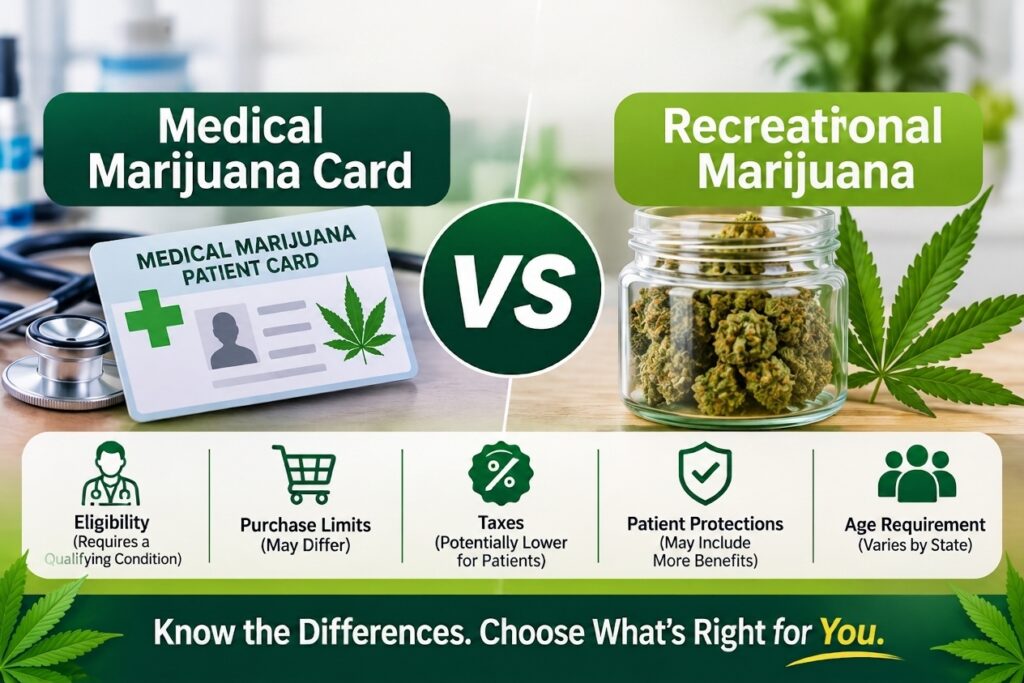
The biggest difference is the purpose and legal framework under which cannabis is accessed. Medical programs are designed for eligible patients, while recreational programs provide regulated access to adults without requiring a medical qualification.
| Feature | Medical Marijuana | Recreational Marijuana |
|---|---|---|
| Main purpose | Access for qualifying patients | Adult personal use |
| Doctor evaluation | Generally required | Not generally required |
| Qualifying condition | Usually required, depending on state | Not required |
| Minimum age | Varies by state; exceptions may apply | Commonly 21 |
| State registration | Required in some form in many programs | Generally not required for consumers |
| Purchase location | Licensed medical dispensaries or authorized retailers | Licensed adult-use dispensaries |
| Possession limits | Set by state medical program | Set by adult-use law |
| Taxes | May have different or lower taxes | Often subject to adult-use cannabis taxes |
| Patient protections | May include additional state-specific protections | Generally fewer medical-program protections |
These are general differences, not universal rules. Some states have combined medical and recreational systems, while others have medical-only programs.
1. Eligibility Requirements Are Different
One of the most noticeable differences is who can access each program.
Medical marijuana eligibility
Medical cannabis programs generally require patients to meet specific eligibility criteria. Depending on the state, this may involve having a qualifying medical condition, receiving a healthcare professional’s certification, and completing a state registration process.
Qualifying conditions vary. Some state programs recognize conditions such as:
- Chronic or severe pain
- Cancer
- Epilepsy and certain seizure disorders
- Multiple sclerosis
- Post-traumatic stress disorder (PTSD)
- Other conditions recognized under state law
Not every condition qualifies in every state. A condition that is accepted in one state may not meet another state’s requirements.
You can learn more about common eligibility categories on our medical marijuana qualifying conditions page.
Recreational marijuana eligibility
Recreational cannabis generally does not require a medical evaluation. Adults who meet the legal age requirement can purchase cannabis from licensed retailers in states where adult-use sales are permitted.
However, age requirements, purchase limits, and other restrictions still apply.
2. Medical and Recreational Purchase Limits May Differ
States establish possession and purchase limits for both medical and recreational cannabis users.
Medical patients may have different limits based on their state’s program. Some states calculate limits using a specific number of days’ supply, while others establish limits by weight, product type, or other measurements.
Recreational consumers typically have a separate possession limit that applies to adult-use purchases.
For example, a state may allow medical patients to possess a different amount of cannabis than recreational consumers. The actual limits depend on the state, and patients should never assume that a medical card automatically allows unlimited possession.
Always check the current regulations in your state before purchasing, possessing, or transporting cannabis.
3. Medical Marijuana May Have Different Tax Advantages
Taxes are another important distinction.
In some states, medical cannabis purchases are taxed at a lower rate than recreational purchases. Certain states may also exempt registered medical patients from specific adult-use cannabis taxes.
Recreational cannabis purchases may be subject to additional state or local taxes, depending on the location.
However, these savings are not guaranteed everywhere. Some states tax medical and recreational purchases similarly, while others have different exemptions and fee structures.
If you’re comparing the cost of medical and recreational cannabis, check the current tax rules and any registration fees in your state.
4. Medical Patients May Have Access to Additional Protections
Medical cannabis programs may provide protections that are not available to recreational consumers.
Depending on state law, registered patients may receive certain protections relating to possession, employment, housing, or other circumstances.
However, these protections are limited and do not apply in every situation.
For example, a state may protect a registered patient’s status while still allowing employers to enforce workplace drug policies in certain circumstances. Federal rules, safety-sensitive job requirements, and other exceptions may also affect a patient’s rights.
A medical marijuana card should not be viewed as blanket protection from every consequence associated with cannabis use.
For more context, read our guide on how state laws differ from federal cannabis laws.
5. Product Access and Dispensary Rules Can Vary
Medical and recreational cannabis programs may offer different products, purchasing rules, or product limits.
In some states, medical patients have access to products or purchase options that differ from those available through the recreational market. Other states operate combined dispensaries that serve both medical patients and adult-use customers.
Product availability can also depend on state regulations, dispensary licensing, and local inventory.
Having a medical card does not mean every dispensary will carry the same products or that every product is appropriate for every patient. A healthcare professional can help discuss health considerations, while dispensary staff can explain the products they are legally permitted to sell.
Can You Have Both a Medical Marijuana Card and Recreational Access?
In states that allow both medical and recreational cannabis, an eligible adult may be able to participate in the medical program while also having access to the adult-use market.
Whether this is possible, and how purchases are handled, depends on state law.
Some people choose to maintain medical registration because they want access to patient-specific purchasing rules, potential tax benefits, or protections available under their state’s medical cannabis program.
Others may prefer recreational access because they do not need to complete a medical evaluation or register as a patient.
If you qualify for a medical program, compare its requirements and benefits with the adult-use rules before deciding which option best fits your circumstances.
Is Medical Marijuana Legal Under Federal Law?
This is an important question because state cannabis laws and federal law do not always align.
As of November 2026, federal cannabis regulation includes an important distinction: a 2026 Department of Justice order moved certain state-licensed medical marijuana and related products into Schedule III under the Controlled Substances Act, subject to the order’s conditions. Recreational marijuana remains Schedule I.
This does not mean that all cannabis is federally legalized or that state medical cannabis programs are automatically equivalent to federally approved prescription drug programs. The legal status depends on the applicable federal rules and the specific product or activity involved.
State laws may permit medical or recreational cannabis use within their jurisdictions, but that does not remove every federal restriction.
Patients should also understand that cannabis cannot automatically be transported across state lines just because it is permitted in both states. Federal property, airports, and other federally regulated settings can involve additional restrictions.
Because these laws can change, review current federal and state guidance before making decisions about possession or travel.
Which Option Is Better: Medical or Recreational Marijuana?
There is no single answer for everyone. The right option depends on your reason for considering cannabis and the laws where you live.
A medical marijuana program may be worth exploring if:
- You have a health condition that may qualify under your state’s law.
- You want to discuss your symptoms and medical history with a qualified professional.
- Your state offers medical-program benefits such as different purchase limits or tax treatment.
- You want to understand the patient protections available under your state’s regulations.
Recreational access may be more straightforward if:
- You are an adult who meets the legal age requirement.
- Your state permits adult-use cannabis.
- You do not need or want to pursue medical registration.
- You are comfortable following the adult-use purchase and possession rules.
Neither option should replace appropriate medical care. If you’re considering cannabis for a health concern, discuss potential benefits, risks, and interactions with a qualified healthcare professional.
How to Explore Medical Marijuana Card Eligibility
If you’re considering a medical marijuana card, the first step is understanding your state’s eligibility requirements.
The process generally involves reviewing your medical history, discussing your symptoms, and completing an evaluation with a qualified healthcare professional.
At Med Card District, we help connect patients with licensed healthcare professionals for medical marijuana evaluations in the states we serve.
Our process is designed to help patients understand the evaluation and certification process, including whether they may qualify under applicable state requirements.
Med Card District offers a 99% approval rate and a 100% money-back guarantee, subject to applicable eligibility requirements and program terms. Approval is never guaranteed, and each patient’s eligibility is determined through the appropriate medical evaluation.
If you’re ready to explore your options, visit Med Card District to learn more about available evaluations and state-specific services.
Frequently Asked Questions
1. Is medical marijuana stronger than recreational marijuana?
Not necessarily. Medical and recreational cannabis products can contain different THC and CBD concentrations, but strength depends on the specific product rather than whether it is sold through a medical or recreational program. State regulations may also affect product availability and potency limits.
2. Do you need a medical condition to buy recreational marijuana?
Generally, no. In states that permit adult-use cannabis, eligible adults can purchase recreational marijuana without having a qualifying medical condition or obtaining a doctor’s certification. Age and purchase restrictions still apply.
3. Is medical marijuana cheaper than recreational marijuana?
It can be cheaper in some states because registered patients may receive lower cannabis taxes or other purchasing benefits. However, the difference varies by state, and medical registration fees may also apply.
4. Can you use a medical marijuana card in another state?
Not automatically. Some states have medical cannabis reciprocity arrangements that recognize certain out-of-state patients, while others do not. Even where reciprocity exists, additional requirements and restrictions may apply. Always check the destination state’s rules before traveling.
5. Does a medical marijuana card protect you from workplace drug testing?
Not necessarily. Some states provide employment protections for registered medical cannabis patients, but these protections have exceptions. Federal requirements, safety-sensitive positions, and employer policies may also affect workplace rules.
6. Can you get a medical marijuana card without a qualifying condition?
That depends on the state’s eligibility requirements. Most medical cannabis programs require a qualifying condition or another recognized basis for eligibility. A healthcare professional must evaluate whether you meet the applicable criteria.
7. Is recreational marijuana legal in every state?
No. State cannabis laws differ significantly. Some states permit both medical and recreational cannabis, some allow medical use only, and others maintain broader restrictions. Check your state’s current laws before purchasing or possessing cannabis.
Final Thoughts
Medical marijuana and recreational marijuana may involve many of the same cannabis products, but the rules governing them can be very different.
A medical marijuana card may provide access to a state-regulated patient program, potential tax advantages, different purchase limits, and certain patient protections. Recreational cannabis offers eligible adults a way to purchase cannabis without completing a medical evaluation where adult-use sales are permitted.
Before choosing either option, take time to understand your state’s laws, eligibility requirements, and restrictions. If you’re considering cannabis for a medical reason, speaking with a qualified healthcare professional can help you make a more informed decision.